No plan, no panic, no quit. Die Hard is actually a love story.
McClane doesn't ask the hostage situation for permission. He improvises, adapts, and keeps moving. Sound familiar?
He's not the action hero. He's the stubborn guy.
John McClane is the only action hero who looks like he might not make it. He's sweating through his undershirt, bleeding from his feet, arguing with a police radio, and completely unprepared for what's happening. He also never stops. He doesn't wait for backup. He doesn't wait to feel ready. He picks a direction and moves, and that is the entire lesson, and it applies directly to the thing you are overthinking right now.
The guys who do well with women are not the guys with the best lines or the sharpest jawline. They're the guys who act before they're certain and keep going when it gets awkward. McClane, dressed in a Christmas party outfit and armed with a stolen pistol and pure stubbornness, is a better dating archetype than any smooth operator in a tuxedo, because smooth operators are playing defense. McClane is always playing offense.
McClane's whole superpower is that he never waits to feel ready. He's already bleeding from his feet. He goes anyway.
What he actually does
He makes a decision without a committee vote. When McClane picks a direction, he picks it. He doesn't check with the group, he doesn't wait for consensus, he doesn't ask the building for permission. He moves. On a date, that looks like choosing the bar without offering seventeen alternatives, picking a follow-up plan without making her vote on it, and texting her the next day without polling your friends first. Decisiveness isn't knowing the right answer. It's committing to an answer and adjusting if it's wrong.
He is honest about how bad things are. McClane does not pretend the situation is fine. He tells Sergeant Al Powell that he's scared, that he's hurt, that he doesn't know if he's getting out. Then he keeps going. That honesty, acknowledging difficulty without crumbling under it, is one of the most attractive things a guy can do. It reads as secure. A man who can say "this is a weird situation" or "I'm actually nervous" and then just continue is more compelling than a guy performing invincibility at every moment.
He improvises. The plan falls apart in the first twenty minutes. Every plan after that is made up on the spot with whatever materials are nearby. The duct-tape-and-fire-hose thing is not a pre-packaged system. It's an adaptive brain working under pressure. That trait, real-time problem solving without freezing, is exactly what you want her to see. When the restaurant is full and you pivot to the wine bar next door without making it a disaster, you just did the Nakatomi improvise. It doesn't require a crisis. It just requires not panicking.
He keeps the sarcasm at a useful level. "Yippee-ki-yay" is a pressure valve. It's one line, delivered with a grin, and then he's back to business. He doesn't perform the wit for the room. He doesn't keep circling back to the bit. He says the thing and moves. That's the right ratio: light enough that she knows you don't take yourself too seriously, brief enough that you're not auditioning.
✦
Out of first date ideas?
Get date plans that actually go somewhere, tuned to your vibe.
Moving before you feel ready, because ready never actually shows up
Showing the frustration briefly, then getting on with it anyway
Making a decision and owning it instead of running it by the room
Staying loose when the plan falls apart
Being the guy who solves the problem instead of describing the problem
Skip this
Turning every date into a survival narrative you're heroically enduring
The running sarcastic commentary that works on film and dies at dinner
Dragging baggage from the last relationship into this one like Hans Gruber followed you across town
Treating her like she needs to be rescued instead of impressed
Leaving your shoes off at a rooftop party and thinking it's a personality
The specific thing to train is what McClane does in the seconds after a bad moment. He doesn't spiral. He doesn't replay the mistake. He takes a breath, says something dry, and gets back to the problem. You can build that exact reflex. You get her number and she flakes on the first plan. Fine. You suggest a different day, once, and you're already thinking about the next approach before you even hit send. The silence after a joke lands badly doesn't kill you. You keep the conversation moving. That turnaround speed is the whole thing.
Where it goes wrong
The cringe version of McClane is the guy who mistakes chaos for charm. The barefoot-in-a-burning-building energy works because the building is actually on fire. If you manufacture drama, if you're always the hero of a story about how much you had to deal with, if every date is a thing you're valiantly surviving, you're not McClane. You're someone she stops responding to after three weeks.
The other failure mode is importing his relationship baggage wholesale. McClane and Holly are separated at the start of the movie. He flew to LA partly to fix it. That's great for the plot. In real life, a guy who's dragging unresolved stuff from his last relationship into every new interaction, who is visibly still fighting the last war, is not charming and complicated. He's just unavailable. Borrow the improvisation and the forward motion. Leave the unresolved divorce energy in the Nakatomi lobby.
What she's actually responding to
She's not responding to the action. She's responding to the fact that he keeps moving. Most guys freeze. They freeze before asking for the number, they freeze when the plan changes, they freeze when she says something unexpected and they don't know the correct answer. McClane is proof that the correct answer is almost never the issue. The issue is whether you stop.
Outcome independence is the underlying principle. McClane doesn't need the next five minutes to go well in order to function. He's already having a terrible night. One more terrible thing is just new information. When you carry that energy into dating, you stop performing and start actually being present, because you're not managing the scoreboard anymore. You don't need this specific text to say the right thing. You don't need this specific date to go perfectly. You're in the game and you're staying in the game and the scoreboard will sort itself out.
That's the thing she feels across the table that she will describe later as "he just seemed really comfortable with himself." He wasn't comfortable. He was committed. There is a difference, and only one of them requires you to actually be comfortable, which you won't be for a while, and that's fine.
✦
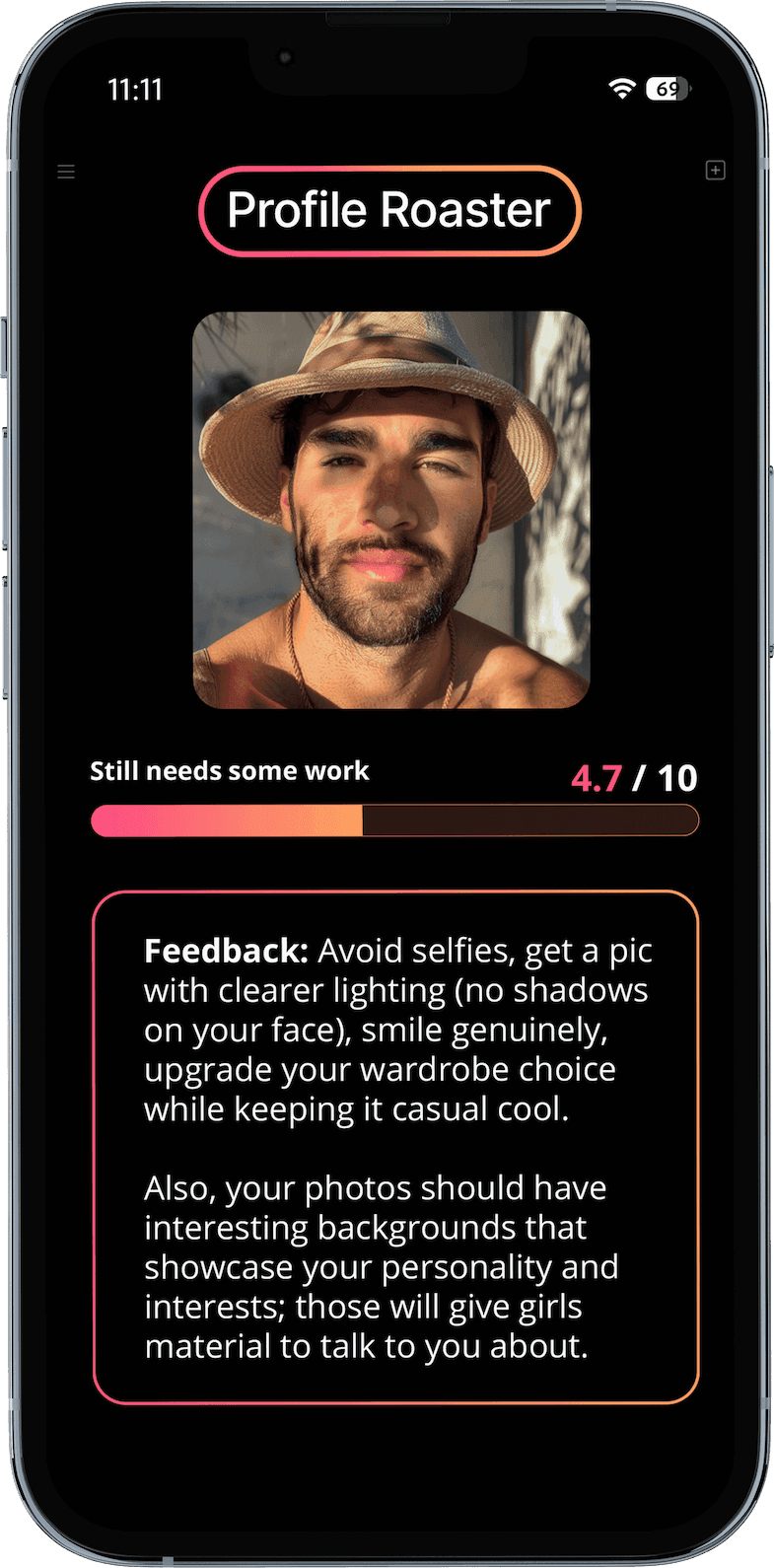
Become a Chad
Use AI to roast your dating pics and transform into a god.
McClane wins not because he's the best guy in the building but because he's the only guy who refuses to stop. That's the move. Not the one-liner, not the undershirt, not the improbable upper-body strength. The refusal to quit when it gets uncomfortable is the entire asset, and it transfers directly to asking someone out when you're nervous, texting after a first date without a guarantee, and walking into the next one after a bad one. Yippee-ki-yay. Go make the move.
Meet your AI dating coach
Your Tinder Pictures Suck
Rizz up your dating profile with AI and get more matches.