Home / What to Say / How to Apologize After a Fight Without Groveling
How to Apologize After a Fight Without Groveling
Own what's yours. Nothing more. Here's exactly what to say.
The rule
An apology is not a confession. Most guys either refuse to apologize at all (too proud) or go so far overboard they turn into a puddle on the floor (too scared). Both lose. The move is to own your part, exactly your part, and stop there. You're not the prosecutor building a case against yourself. You're a person who did one specific thing wrong and is saying so directly.
The grovel is its own kind of cowardice. It feels like humility but it's actually fear: fear she'll leave, fear she's still angry, fear the silence means something permanent. So the guy floods her with apologies, calls himself the worst, says she deserves better, and wonders why she feels less safe with him, not more. She doesn't want a guy who falls apart when things get hard. She wants a guy who can look at what happened, take ownership of his piece, and still be standing afterward.
An apology is not a confession. Own your part, exactly your part, and stop there.
What a real apology looks like
Three components. That's it. First: name the specific thing you did. Not 'I'm sorry for everything' or 'I'm sorry if I upset you.' Both of those are ways of apologizing without saying anything. Name it: 'I was dismissive when you were trying to tell me something that mattered to you.' 'I raised my voice and that wasn't okay.' 'I said something mean that I didn't actually mean and I let it sit there too long.' Specificity is what turns a hollow ritual into something she can actually receive.
Second: own it without a but. 'I'm sorry I said that, but you were also...' is not an apology, it's a negotiation. If you have a legitimate grievance about her behavior, you address it separately, at a different moment, when you're not in the middle of making amends. The apology gets its own clean space. If you contaminate it with a counter-complaint, she'll only hear the counter-complaint and the apology will disappear.
Third: say what you want to happen. Not 'please forgive me, I need you to be okay with this.' That's pressure. Something more like 'I'd like to talk tonight' or 'I don't want this to sit between us.' You're naming the direction you want to move in, not demanding she hand over absolution on your timeline.
Text is fine to break the ice after a fight, especially if things have gone cold and neither of you has said a word in a day or two. You need something to re-open the door and a short text does that. But if you try to fully resolve a real fight over iMessage you will fail. Text flattens tone, removes context, and gives both people plenty of room to misread. One neutral sentence can land as passive-aggressive. A genuine apology can read as sarcastic. Get in front of her or on the phone as fast as you can manage.
The play: text to signal you want to fix it, then move it. 'I don't want to do this over text, can we talk tonight?' is nine words and it upgrades the whole conversation. You're telling her you take this seriously enough to actually talk, not just fire off a message and wait. That alone says something.
Right after the fight if it was minor and the air just needs to clear: a short text that night or the next morning works fine. If it was a real blow-up with things said that shouldn't have been, give it a beat. Not three weeks. A day, maybe two. Enough time that you've actually processed what happened and aren't just reaching out because the silence is killing you. An apology sent purely to stop your own anxiety usually sounds like it was sent to stop your own anxiety.
Don't wait for her to go first. That's a pride game and it helps no one. Going first doesn't mean you're weak; it means you're the one willing to act. That's leadership, not submission. If you were wrong, say so. Whoever was wrong should say so. Don't tally the score, fix the problem.
What not to send (ever)
The wall of text at 1am that relitigates the entire fight from your perspective, names every grievance, explains all your reasoning, and ends with a list of things you'd like her to also apologize for. This is the most common mistake and it is catastrophic. She reads 'block of text' before she reads a single word and she already knows what kind of energy is coming. Long apology texts almost never land because they're not really apologies, they're closing arguments.
Also off the menu: 'I'm so sorry, I'm the worst, you deserve so much better than me.' This is supposed to read as humble but it reads as a man telling her she's with a worthless person. That's not comforting. It's anxiety-inducing. She either has to reassure you (exhausting) or agree with you (also bad). Don't make her manage your self-esteem while you're supposed to be apologizing.
And don't end the apology with 'so are we good?' Give it room. Say what you needed to say, let it land, and trust her to come back when she's ready. The 'so are we good?' is you trying to close a loop that she hasn't finished processing yet. Patience is part of the apology.
'I was short with you and that wasn't fair. sorry.'
'I said something I didn't mean. that's on me.'
'I don't want to do this over text. can we talk tonight?'
'I've been thinking about what happened. I reacted badly.'
Never send this
'I'm sorry you felt that way'
'I'm SO sorry, I'm literally the worst'
'I'm sorry BUT you also...'
A 400-word text sent at 1am
'So are we good?' immediately after the apology
The Messages
Clean, direct apology (you were actually wrong)
hey. I was short with you last night and that wasn't fair. genuinely sorry.
thank you. that means a lot actually
good. talk later?
Why this works: Three sentences. You name what you did wrong, you own it without a paragraph of justification, and you don't grovel or ask for forgiveness five times. The 'talk later?' signals you're still the same guy, not a wounded animal waiting for her verdict.
When you were both wrong but you're going first
I said some things I didn't mean. that part's on me. I think we were both spinning out but I'm not going to let that sit.
yeah... me too. I didn't mean all of it either
I know. let's talk tonight.
Why this works: You own your slice without confessing to crimes you didn't commit. 'I think we were both spinning out' is observation, not accusation, and it gives her an opening to meet you halfway. Saying 'I'm not going to let that sit' shows leadership, which is more attractive than waiting three days hoping it resolves itself.
Defusing a cold-shoulder situation (she's gone quiet)
I don't love how we left things. I'm not going to keep poking at it over text but I'd rather talk it out than let it go cold. let me know when you're ready.
okay. tonight works
good. I'll call at 8.
Why this works: You're not begging her to respond, you're telling her your position: you want to fix it, you're not going to do it over text, and the ball is now in her court. Calm, not cold. The 'I'll call at 8' moves it off text entirely, which is almost always the right call after a real fight.
After a big blow-up (more serious, a few days later)
I've been thinking about what happened. I reacted badly and said things I shouldn't have. I'm not proud of it. I don't want that to be the version of me you remember from this.
I appreciate you saying that. I wasn't great either.
I know. I just wanted you to hear mine first. can we get coffee this week?
Why this works: Longer, because the situation earned it. But notice there's still no paragraph of self-flagellation, no 'please forgive me, I'm the worst.' You name the specific bad behavior, you say you're not proud of it, and you express what you want the outcome to be. 'I wanted you to hear mine first' is confident, not competitive, it shows you're taking ownership without waiting to see if she goes first.
Common Mistakes
"I'm sorry you felt that way" (this is not an apology, it's a lawsuit)
A wall-of-text message at 1am listing every grievance from both sides
"I'm SO SO sorry, I'm the worst, you deserve better" (you just told her you're worthless)
Apologizing before you've figured out what you're actually apologizing for
Double-texting the apology because she didn't respond in two hours
Ending with 'so are we good?' right after the apology (give it room to breathe)
Bringing up what she did wrong inside the same message where you're apologizing
The honest part
Owning your part isn't the same as owning everything. You can be genuinely sorry for what you did without accepting that the whole fight was your fault. The guys who grovel hardest are usually the guys who are most afraid of the relationship ending, which means they're negotiating from scarcity, and she feels it. Apologize like a man who knows what he did wrong, says so plainly, and still has his feet on the ground. That version of you is easier to forgive, and more worth forgiving.
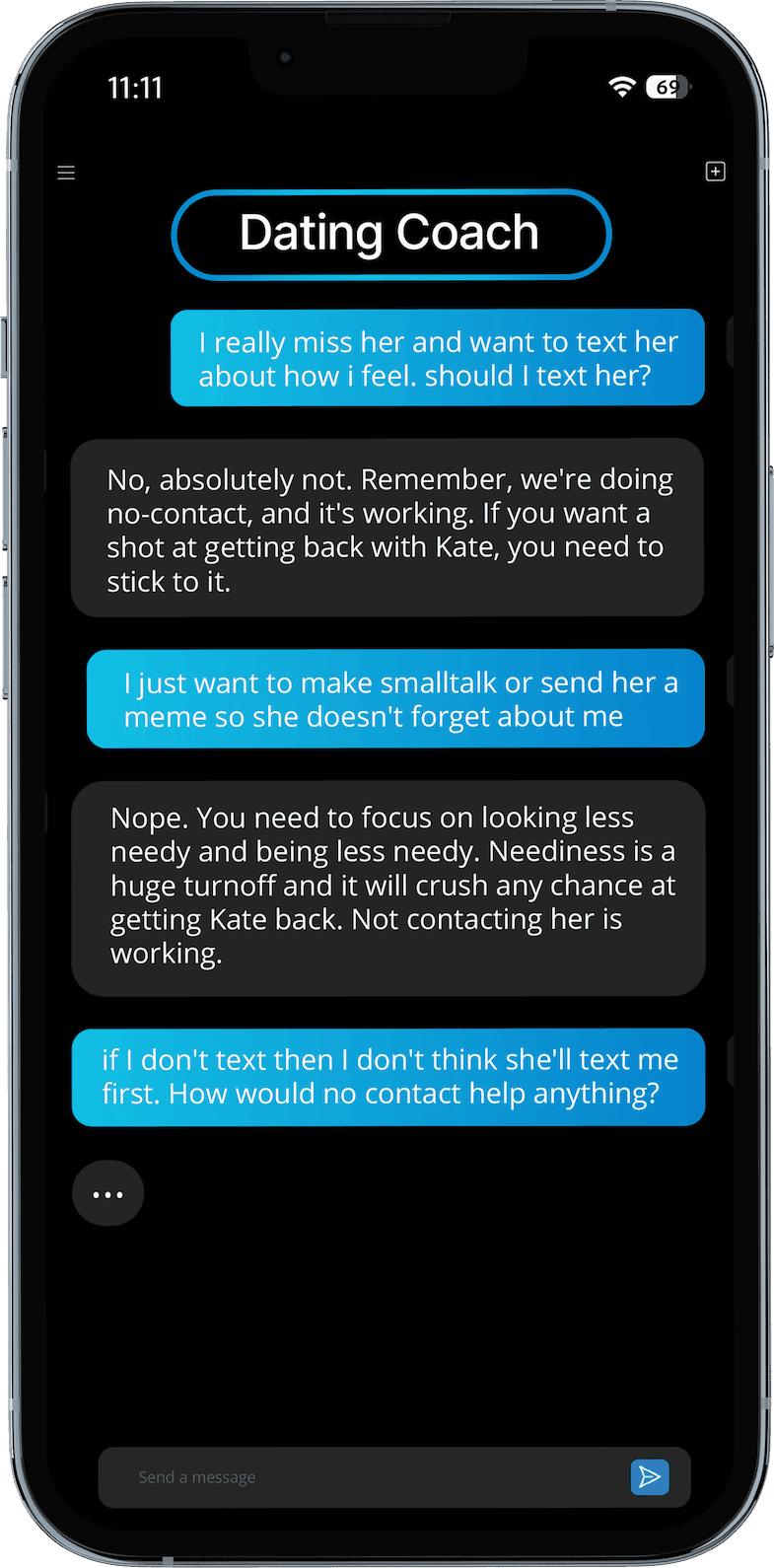
Meet your AI dating coach
Get the Best Advice
Wingman is the AI dating coach with answers to every dating question, 24/7.